⚡ In 30 seconds
- 90–95% of calls are orders, which AI can already take.
- AI logs complaints; compensation follows predefined rules.
- Order changes and packing still need people.
A restaurant dispatcher has four main tasks. Let's see which ones AI can take over:
1. Order taking — AI handles it (90%+)
This accounts for 90-95% of calls. The guest wants to order, and AI handles it perfectly: menu knowledge, side selection, slang recognition, payment method, address — everything is covered. The safety net is the live human dispatcher network: if someone can't manage with the AI, a trained central dispatcher calls back, takes the order, and if needed, teaches the guest proper communication so they'll know how to use AI next time.
2. Complaint handling — AI + human backup
AI can handle complaints: it identifies the guest, finds their last order, and records the problem in a detailed report format. Compensation follows pre-defined rules — we'll cover this in more detail in the next section.
3. Order modification — currently handled by humans
If someone wants to add a Coke five minutes after ordering, that requires a more complex decision: you need to check whether the courier has already left or the kitchen has already prepared the food. This requires human judgment, but the system's status data (in kitchen, ready, with courier) makes future automation possible.
4. Address assignment and courier management — software + AI prioritization
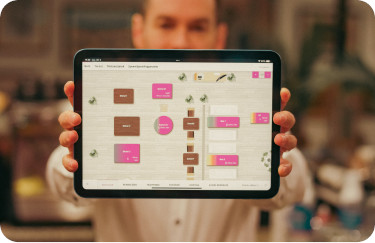
The software can already prioritize the kitchen: it sees what items are in, how long they take to prepare, how loaded each kitchen station is, and what further orders are still pending. Full automation requires the restaurant to consistently use the system — the kitchen staff always pressing the "ready" button, the courier signaling departure and delivery.
5. Packaging — stays with humans
This is physical work that AI can't solve (currently). But it requires lower skills than organizational tasks, making it much easier to find people for this.
"When the software truly and completely controls this part, you basically don't need to think anymore. Everyone's job is simply to complete the next task the system assigns them."
How does AI handle complaints?
Complaint handling is the area where AI provides the biggest competitive advantage — because it does it professionally, consistently, every single time.
The complaint handling process:
- Identification — AI recognizes the caller's number and finds their last (or active) order.
- Recording — The system records complaint details in report format: which dish, which order, exactly what the problem is.
- Decision — The system compensates based on pre-defined rules: e.g., if delivery took more than 2 hours, it automatically offers a 2,000 HUF coupon to the guest, preventing bad feelings (and a 1-star Google review).
- Human review — A person reviews the summary, filters out abuse cases, and intervenes if necessary.
- Compensation — The guest receives the coupon via SMS or email.
- Closure — The owner gets a notification: what happened, how it was handled, and whether any action is needed (99% of the time, it isn't).
"A professional complaint handling system that only the TOP 1% of restaurants have. Very, very rare, and only the most successful ones do it this consistently."
AI also tracks abuse. If someone regularly files complaints, the system flags it — unlike human dispatchers who rotate and don't remember that "it was them last time too."
SMS confirmation as a safety net
After ordering, the guest immediately receives an SMS with the order summary:
- What they ordered?
- What address?
- What name?
- Payment method.
After the SMS is sent, the guest has 3 minutes to modify anything or simply accept. If they don't even open it, the system flags: "This guest didn't check the SMS." Then the operator reviews the order and corrects or calls if necessary.
Additionally, a second, more thorough AI reviews the order before submission. If the first one misunderstood something, the second one catches it.
When the restaurant accepts the order, the guest receives a second SMS: e.g., "Your order is confirmed, estimated preparation and delivery time: 43 minutes."
Want to know how much a restaurant saves with an AI dispatcher? Read our next article!
Want to listen to our podcast on this topic?
Click to visit the Profitable Restaurant Podcast page
FAQ
Can AI fully replace a dispatcher?
Not fully: it takes orders and complaints, but changes and packing still need people.
How does AI handle complaints?
It identifies the caller, finds the order, logs the issue and offers rule-based compensation.